City Cast DC logo

Reliving RFK Stadium's Glory Days

Posted on July 28, 2025   |   Updated on September 30, 2025
Kaela Cote-Stemmermann

Kaela Cote-Stemmermann

Fans line up outside the ticket offices at RFK Stadium to buy playoff tickets on January 6, 1983. The Washington Redskins met the Detroit Lions in a playoff game. (The Washington Post/Getty Images)

Fans line up outside the ticket offices at RFK Stadium to buy playoff tickets on January 6, 1983. The Washington Redskins met the Detroit Lions in a playoff game. (The Washington Post/Getty Images)

The D.C. Council is voting on the revised RFK Stadium deal on Aug. 1, which, if approved, would bring the Washington Commanders back to D.C. As the possibility of their return approaches, we couldn’t help reliving the Commanders glory days with longtime fan and Washington Post columnist Kevin Blackistone.

RFK Stadium, originally known as D.C. Stadium, became one of the first stadiums ever built that could host both football and baseball. The Washington Redskins played their first game at the stadium on Oct. 1, 1961 and went on to win three Super Bowls during their time in D.C.

The Redskins captured the region. On Sundays, grocery stores in D.C. would be empty. Elementary schools had Redskins pep rallies (some core memories for many on our team). Once, in the 80s, the team lost a game in Kansas City and 20,000 people still showed up at the airport to welcome them back. Then, when they won their first Super Bowl, President Reagan and Mayor Barry gave federal and city workers D.C. two hours paid leave to go to the celebration parade.

Sundays in our house were much less likely to be spent in the house of worship, unless you considered that house of worship to be D.C. Stadium.Kevin Blackistone, Washington Post Sports Journalist

Of course it wasn't all roses. RFK Stadium also played a role in D.C.’s civil rights history. When the Redskins owner at the time, George Preston Marshall, refused to integrate his team, President Kennedy forced his hand by denying the team access to the then-federal stadium unless it was desegregated. Marshall relented and drafted a black player, Ernie Davis, becoming the last NFL owner to integrate. Not D.C.’s proudest moment.
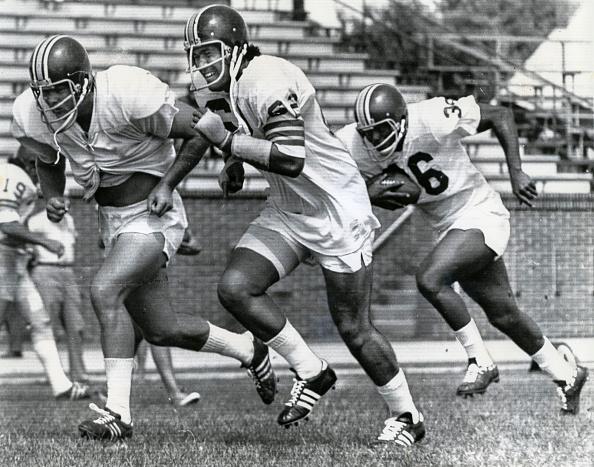
Washington Redskins Paul Laaveg, left, and tackle Ray Schoenke lead blocking for Charley Harraway on July 27, 1972. (The Washington Post/Getty Images)

Washington Redskins Paul Laaveg, left, and tackle Ray Schoenke lead blocking for Charley Harraway on July 27, 1972. (The Washington Post/Getty Images)

The team relocated 35 years later to Landover, Maryland, but RFK Stadium still saw success hosting matches in the 1994 World Cup and 1996 Summer Olympics. It also hosted The Beatles’ penultimate concert in front of 32,000 fans and a mass wedding with over 40,000 guests.

With the team in Maryland and Dan Snyder taking over as owner in 1999, local fanaticism over the team faded. The small neighborhood feel at games was gone and fans turned to other sports like baseball and basketball for their fix.

Bringing the team back to D.C. would be a big point of pride for the city. (Indeed, Mayor Bowser and the team are relying on that nostalgia to help sell the deal). But, will it actually bring back the glory days?

“ It'll be different, but the enthusiasm and pride that people had in the old team, I certainly think that can happen again,” said Blackistone. As someone who was too young to experience the early days of RFK stadium, I certainly hope so.
Stories From RFK’s Glory Days

Share article

Hey DC

Stay connected to City Cast DC and get ready to join the local conversation.

Can't subscribe? Turn off your ad blocker and try again.

DC History

See All
DC HistoryMarch 30

The Rise & Fall of DC’s Iconic Wrestling Institution

At the height of the Great Depression in 1935, a small-time D.C. wrestler named Joe Turner opened what would become the city’s most succe...

 Joe Turner's arena
DC HistoryFebruary 17

Washington DC’s First Chinese Restaurants

D.C.’s Chinatown is a bit lackluster in terms of authentic cuisine, but that wasn’t always the case. Restaurants were some of the first C...

Port Arthur restaurant, Washington D.C. The largest Chinese restaurant in the city in 1909, owned by early restaurateurs Ung Wah. (Streets of Washington/Flickr)
DC HistoryJanuary 27

How This Storm Compares To DC’s Largest

Sunday’s snowstorm in D.C. was remarkable, not only because of how much snow we got but because the combo of cold temps and sleet means i...

Horse-driven sleigh on a snowy path near the Lincoln Memorial (Bettmann/ Getty Images)
DC HistoryNovember 18, 2025

6 Spy Sites In Washington, DC That Changed History

This nondescript park in Foggy Bottom, close to the State Department, has seen its fair share of spy activity.

Peirce Barn 1972. (HABS Survey/NPS)
DC HistoryOctober 23, 2025

DC’s Secret Séance History

In Gilded Age Washington, D.C., séances and Ouija boards weren’t just parlor tricks — they were part of a craze that swept through societ...

An illustration from the 19th century of a spiritual séance. (clu/Getty Images)
DC HistorySeptember 23, 2025

From The Archive: How DC Became a Showcase of Brutalism

Love them or hate them, Brutalism has become a central part of D.C.’s iconography over the years. Here's why.

DC Metro ceiling. (Ralph Grunewald/Getty Images)
DC HistoryAugust 26, 2025

The Glen Echo Carousel that Became a Civil Rights Movement

Tucked away in Glen Echo Park is one of the world's most elaborate and historic carousels that played a surprising roll in the Civil Righ...

The Glen Echo Dentzel carousel gets a last minute touch up before the season's inaugural ride. (The Washington Post/Getty Images)
DC HistoryAugust 11, 2025

The Wildest DC Political Scandals (That Didn’t Happen on Capitol Hill)

Case in point: the ongoing drama surrounding Ward 8 Councilmember Trayon White, who said on Friday (during his swearing-in ceremony after...

Portrait of Washington DC Mayor Marion Barry