City Cast DC logo

From The Archive: How DC Became a Showcase of Brutalism

Posted on September 23, 2025   |   Updated on September 30, 2025
Kaela Cote-Stemmermann

Kaela Cote-Stemmermann

Last month, President Trump signed an executive order mandating classical and traditional architecture for federal buildings and admonishing the use of brutalist architecture in D.C. While the District’s brutalist buildings have certainly drawn a fair amount of hate, am I the only one who kind of adores them?

Love them or hate them, they have become a central part of D.C.’s iconography over the years and here’s why.

What Qualifies As Brutalism?

Many think Brutalism refers to the brutal or harsh looking quality of the buildings. But actually, it comes from the term béton brut, meaning raw concrete. It was at its peak in D.C. in the 60s and 70s and still makes up a large part of the city with its bold geometric shapes and utilitarian feel.

Why Does DC Have So Much Brutalism?

Following World War II, the federal government expanded dramatically in D.C. As the number of federal agencies grew, they needed space to bring all their employees to the District. Brutalism offered a quick and inexpensive way to build office buildings. So D.C. ended up with tons of buildings — like the HUD and the FBI buildings — that break the city’s otherwise Neoclassical style.

Hirshhorn Museum and Sculpture Garden, 1978. (Smithsonian Archives)

Hirshhorn Museum and Sculpture Garden, 1978. (Smithsonian Archives)

Our Favorite DC Brutalism Icons

🍩 The Hirshhorn:

When the Hirshhorn opened in 1974, architecture critics had a field day, calling it “the largest doughnut in the world,” “an illuminated babka,” and “a gesture of urbanistic arrogance.” The museum — funded by Joseph Hirshhorn and designed by Gordon Bunshaft — had a particularly rocky start. Before opening, the designer of the first exhibition died, there was a bribery scandal, and some paintings were stolen. So, not the biggest hit at first, but now it’s seen as a prime example of brutalist architecture around the world.

🚆 The Metro:

D.C. Metro is an under-celebrated modernist masterpiece. Designed by Harry Weese and opened in 1976, Metro’s deeply coffered, column-free vaults evoke the descent into Hades and are a classic example of Brutalism in D.C. The design is also extremely practical. The ceiling design encourages airflow that keeps stations cool without A/C and softens the sound of incoming trains. The low, indirect lighting serves up dramatic shadows reminiscent of a moody cocktail bar, thanks to lighting designer William Lam.

🏢 J. Edgar Hoover Building:

Currently home of the FBI headquarters (although not for much longer), the J. Edgar Hoover Building is famously crumbling. The 1970s brutalist behemoth has consistently been deemed as the “the ugliest building in the world” and may be the District's most universally reviled landmark. But at 2.8 million square feet, it provided much needed government office space when it opened in 1975.

Learn More About Brutalism In DC 🎧
see more:history

Share article

Hey DC

Stay connected to City Cast DC and get ready to join the local conversation.

Can't subscribe? Turn off your ad blocker and try again.

DC History

See All
DC HistoryMarch 30

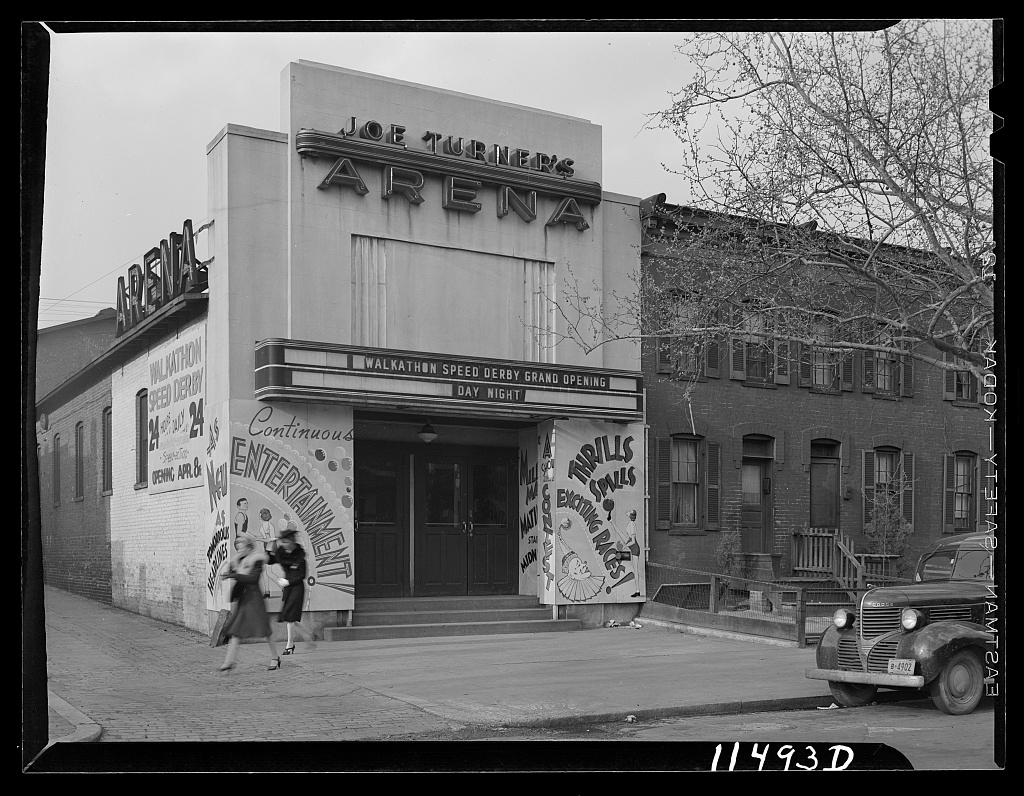
The Rise & Fall of DC’s Iconic Wrestling Institution

At the height of the Great Depression in 1935, a small-time D.C. wrestler named Joe Turner opened what would become the city’s most succe...

 Joe Turner's arena
DC HistoryFebruary 17

Washington DC’s First Chinese Restaurants

D.C.’s Chinatown is a bit lackluster in terms of authentic cuisine, but that wasn’t always the case. Restaurants were some of the first C...

Port Arthur restaurant, Washington D.C. The largest Chinese restaurant in the city in 1909, owned by early restaurateurs Ung Wah. (Streets of Washington/Flickr)
DC HistoryJanuary 27

How This Storm Compares To DC’s Largest

Sunday’s snowstorm in D.C. was remarkable, not only because of how much snow we got but because the combo of cold temps and sleet means i...

Horse-driven sleigh on a snowy path near the Lincoln Memorial (Bettmann/ Getty Images)
DC HistoryNovember 18, 2025

6 Spy Sites In Washington, DC That Changed History

This nondescript park in Foggy Bottom, close to the State Department, has seen its fair share of spy activity.

Peirce Barn 1972. (HABS Survey/NPS)
DC HistoryOctober 23, 2025

DC’s Secret Séance History

In Gilded Age Washington, D.C., séances and Ouija boards weren’t just parlor tricks — they were part of a craze that swept through societ...

An illustration from the 19th century of a spiritual séance. (clu/Getty Images)
DC HistoryAugust 26, 2025

The Glen Echo Carousel that Became a Civil Rights Movement

Tucked away in Glen Echo Park is one of the world's most elaborate and historic carousels that played a surprising roll in the Civil Righ...

The Glen Echo Dentzel carousel gets a last minute touch up before the season's inaugural ride. (The Washington Post/Getty Images)
DC HistoryAugust 11, 2025

The Wildest DC Political Scandals (That Didn’t Happen on Capitol Hill)

Case in point: the ongoing drama surrounding Ward 8 Councilmember Trayon White, who said on Friday (during his swearing-in ceremony after...

Portrait of Washington DC Mayor Marion Barry
DC HistoryJuly 28, 2025

Reliving RFK Stadium's Glory Days

As the possibility of the Commander's return to D.C. approaches, we couldn’t help reliving some of their glory days with longtime fan and...

Fans line up outside the ticket offices at RFK Stadium to buy playoff tickets on January 6, 1983. The Washington Redskins met the Detroit Lions in a playoff game. (The Washington Post/Getty Images)