
Theodore Roosevelt Island, a 88.5-acre nature preserve that’s only accessible by footbridge, has been home to indigenous peoples, plantation slaves, Civil War troops, and more. It only became the oasis we know today in the 1960s, when it was listed on the National Register of Historic Places.
Early Inhabitants
The Nacotchtank Indians are the earliest known inhabitants of the island. The tribe was forced there in the 1660s after John Smith and early settlers pushed them out of their home in Anacostia. But by the 1700s, the tribe merged with the Piscataways and other northern tribes, moving off the island.
Ruins of a Plantation
The island was then bought by the Mason family, who built a mansion and operated a cotton and corn plantation there. The mansion became the “center of Washington and Georgetown society,” and John Mason kept a perpetual open house. Presidents Washington, Jefferson, Madison, and Monroe all spent time there. The estate had 20-25 enslaved staff year-round who lived and worked on the grounds, doing everything from tending the fields and orchards to setting up lavish parties and events.
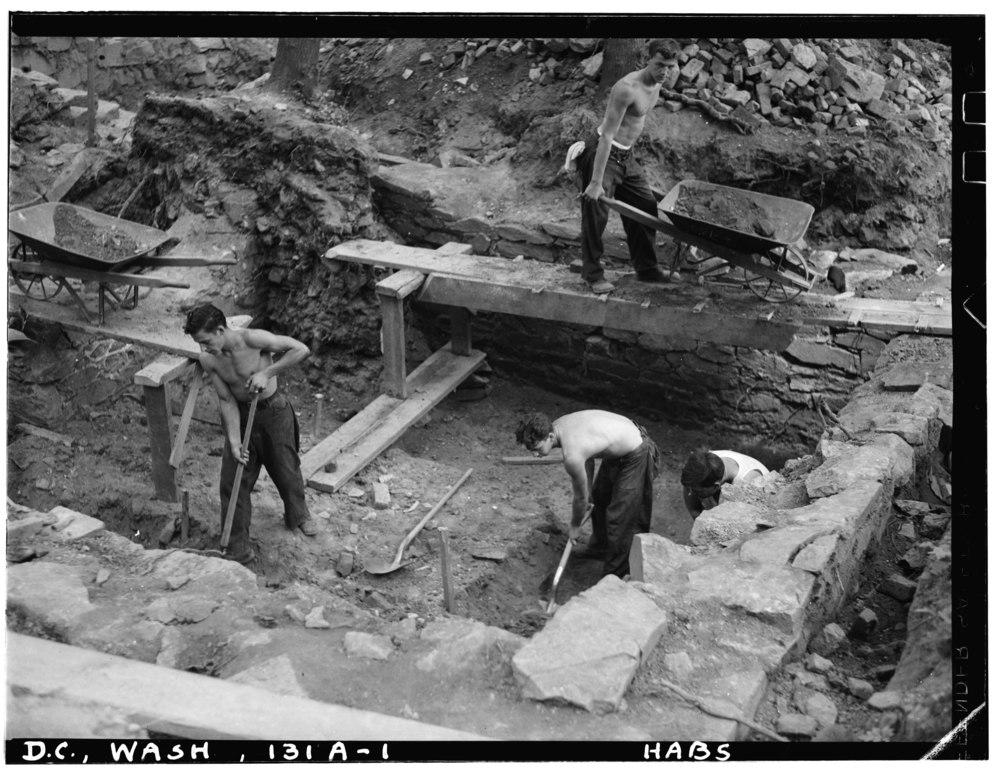
Excavating General John Mason’s House, Theodore Roosevelt Island, 1936. (John O. Brostrup/Wikimedia Commons)
Home of the 1st U.S. Colored Infantry
The Civil War brought an end to the Mason Mansion and transformed the island into a U.S. Army training camp called Camp Greene where the First U.S. Colored Infantry trained. From 1864 to 1865, the island housed 1,200 Black soldiers. As the war dragged on, it also became a relief camp for self-emancipated Black families fleeing nearby Confederate territories.
Becoming Roosevelt Island
The Washington Post and Washington Times said leaders considered a contagious disease hospital and “a public pleasure ground” as options for the island. However, in 1931, the Roosevelt Memorial Association purchased the island and began the 30-year process of transforming it into the park we know today.