
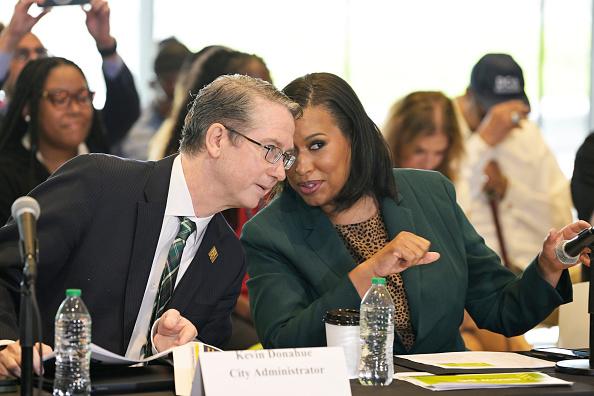
Mayor Bowser’s long-awaited budget for the 2026 fiscal year scales back social programs, opting to focus on economic growth and fixing D.C.’s $1B budget gap.
But the move has been controversial, and many worry that growth without sufficient human services could lead to displacement and the abandonment of the city’s most vulnerable residents.
A Tough Economic Context
The budget comes at a critical time for the District. Federal cuts have resulted in an estimated loss of 40,000 federal jobs in D.C. There are signs of a local recession fast approaching. Not to mention that the city is still scrambling to cover the $1B dollar budget cut that Congress has left the city.
Bowser’s Unpopular Solution
To find more revenue, Bowser has proposed some unpopular cuts, including repealing I-82 — the plan to eliminate the tipped minimum wage — scaling back D.C. Healthcare Alliance, and tightening who is eligible for Medicaid.
Some members of the D.C. council are less than thrilled. Ward 4 Councilmember Janeese Lewis George said she is alarmed and concerned about some of the cuts to vital programs. And Ward 5 Councilmember Zachary Parker said D.C. shouldn’t be balancing its budget on the backs of its most vulnerable residents.
And council members aren’t the only ones. The DC Fiscal Policy Institute came out with a pretty scathing review, saying the budget “squanders D.C.’s limited resources on ineffective strategies.” However, no one is yet to offer solutions for the real financial pickle D.C. finds itself in. It will be a difficult needle to thread.
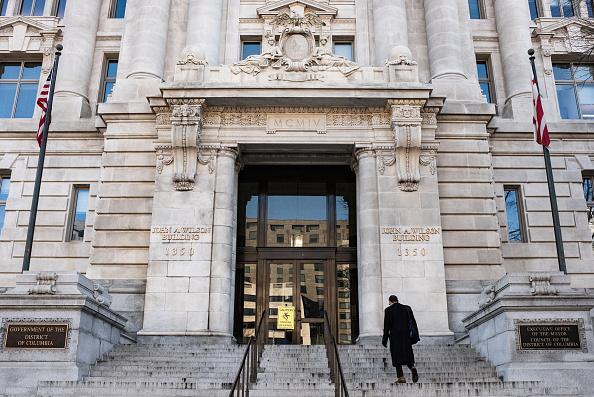
The John Wilson Building, home of the D.C. Council, Washington, D.C. (Salwan Georges/The Washington Post/Getty Images)
Between the Lines
As part of her budget, Bowser is pushing to quietly repeal D.C.’s sanctuary city status, a 2019 law that restricts agencies like the D.C. police and the Department of Corrections from cooperating with ICE.
Also, notably absent from the budget is funding for I-83, the voter-approved initiative that would implement ranked-choice voting and semi-open primaries in D.C. for the 2026 election.
What’s Next for DC’s Budget
The D.C. Council has 70 days to review Bowser’s proposal, make any changes, and cast their final votes before the budget is finalized.