

Donald Trump’s federal downsizing could leave a lot of high profile federal buildings hitting the market. One cluster of them sits just south of the Mall on Independence Avenue and stretches down towards The Wharf. D.C. planners think that this change has the potential to create a whole new neighborhood. We chatted with the Washington Post’s Aaron Wiener about how this could become a reality.
Back Up, Why Are We Getting Rid of Buildings?
The General Services Administration, which manages real estate for the federal government, wants to get rid of 50% of its property under the new administration to help save money. A lot of that property is in D.C. The Southwest quadrant in particular is stacked with federal buildings prone to cuts.
What Buildings Are On the Chopping Block?
Specifically, the Federal Government is looking to get rid of the Department of Agriculture South Building, the Forrestal Building of the Department of Energy, the Bureau of Engraving and Printing, the Sydney Yates building, some Transportation Department buildings, and a number of other smaller federal buildings.
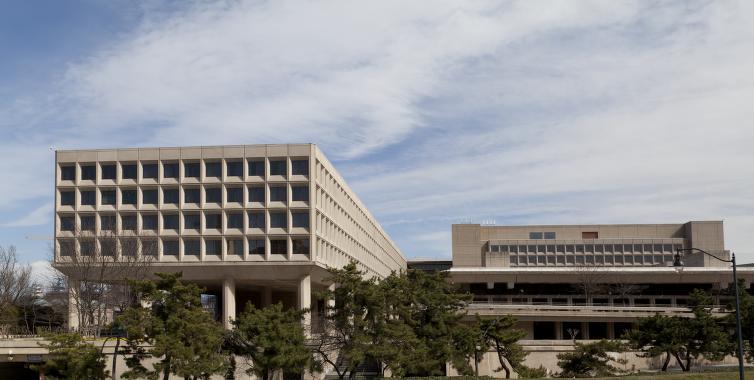
The James V. Forrestal Building looms between the National Mall and The Wharf. One of several buildings the federal government is considering shedding in an effort to downsize. (Highsmith, Carol M./Library of Congress)
What’s the Silver Lining?
Right now, that area is a dead zone after work hours. While getting rid of federal buildings will undoubtedly have profound impacts, it also makes space for D.C. to make a new neighborhood that connects the National Mall to The Wharf. “The city is salivating at the opportunity to convert some of these hulking old obsolete federal buildings into something new and livelier,” said Wiener.
What Would This Neighborhood Look Like?
Federal and city officials invited an architect to create renderings of the hypothetical neighborhood. It included restoring the D.C. street grid (currently cut off), installing a green promenade on 10th St. SW, and converting offices into apartments and retail buildings.
How Realistic Is All This?
Of course, this is all easier said than done. Historic preservation limitations, office conversion permits, and funding issues are just a few of the hurdles D.C. could face in bringing this vision to life.