
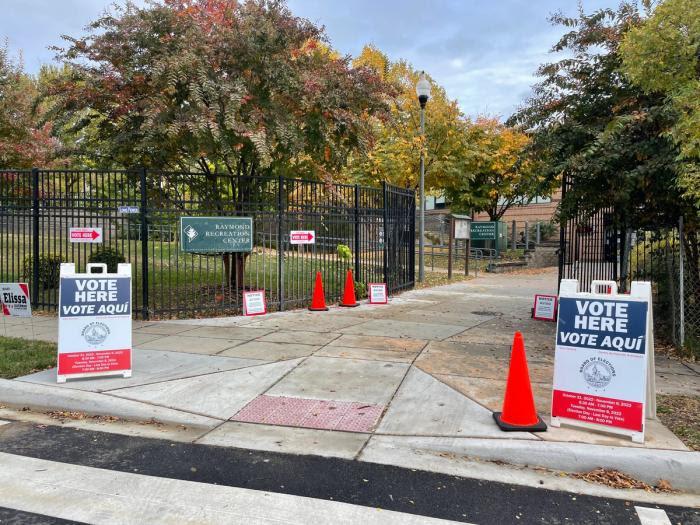
There are not a lot of competitive races on your D.C. ballot this November, but there is one very important referendum that has the potential to seriously shake up D.C. politics – Initiative 83. We chatted with organizers for and against the initiative to help us decide how to vote.
What Is I-83 Exactly?
The initiative has two main components: opening up primary elections and changing how votes are tabulated. Here’s what that means.
🔓 Semi-Open Primaries: There are over 70,000 independent voters in D.C. who are currently barred from participating in the primary elections. I-83 would allow them to vote in either the Republican or Democratic primaries.
✅ Ranked Choice Voting: Rather than choosing one candidate on the ballot, voters would rank candidates by preference. So if someone doesn’t win more than 50% outright, the candidate with fewest first-preference votes gets eliminated and ballots for that candidate get evaluated based on their second choice. On it goes until one candidate gets a majority of votes.
Voting could look a lot different in D.C. (Hill Street Studios/Getty Images)
How Would Ranked Voting Change Who Wins?
Ranked choice voting makes sure that there is a majority winner. Brian Strege, one of the organizers of I-83, says the proposed framework would fix what he considers a huge flaw in D.C.’s current system.
Strege: “Under our current system, you don't need to get that many votes from your own constituents to get yourself a seat on the council. In Ward 7, we just had a 10 way primary where the winner was Wendell Felder, who got 26% of the vote. I-83 is about letting more people vote and giving voters more choices.”
However, Deirdre Brown, one of the organizers behind “Vote No On I-83,” says the proposed system could cause weak candidates to rise to the top.
Brown: “One of the biggest concerns with ranked choice voting is that although they're saying you're going to have someone who has the most votes, it's a false majority. As you go through the rounds of tabulations, someone who would never have won actually ends up being the victor.”
How Would it Affect DC’s Minority Voters?
One common critique of ranked choice voting is that it is more confusing and could therefore, Brown says, disenfranchise minority voters. Strege says this is not accurate in practice.
Strege: “That's not true. If you look at the New York City election yes, the mayoral race has fewer rankings from minority communities. But, if you look at other races there, such as the City Council, there were actually higher rankings. I think it's insulting to say minority communities don't know how to rank things. People rank things every day here in D.C.”
Brown: “Studies do show that there is a high instance of not being able to complete the ballot accurately in certain marginalized communities. The University of Minnesota concluded that ranked choice voting favors white voters who turned out at a higher rate and completed their ballots more accurately.”
How Will I-83 Change DC Politics?
Strege argues that it would make it easier to unseat incumbents and make politicians need to work harder for their win.
Strege: “People would have to campaign differently, and it would be a good thing. Incumbents would learn that they can't just cater to their base. They would actually have to expand their messaging for more constructive campaigns.”
But Brown says the people running against incumbents simply aren’t good enough and worries that ranked choice voting could reverse progress we’ve made in ensuring diverse leadership.
Brown: “We believe that ranked choice voting could change significantly who's sitting in the Wilson Building. And we believe that’s on purpose. We have a long history of having women and people of color. So all we can assume is that they're trying to reverse the progress we've made.”
Learn More
These are just the arguments for one half of i-83! Learn about the arguments for and against the second part, semi-open primaries.